Showing posts with label kidney problem. Show all posts

Tuesday, November 15, 2011

Kidney Stones

>Kidney stones are solid concretions or calculi (crystal aggregations) formed in the kidneys from dissolved urinary minerals.


It typically leave the body by passage in the urine stream, and many stones are formed and passed without causing symptoms.

Man expels the urine large amounts of calcium salts, uric acid, phosphate, oxalate, cystine, and possibly other substances such as penicillin and diuretics. In some conditions the urine is saturated these crystals and consequently formed calculations. It is a rare phenomenon until the age of 70 years. Approximately 15% of men and 8% of women may have at least one assessment during their lives. The first decade of life is not immune to the emergence of calculations, with a peak incidence between four and seven years old. The disease is most common in young adults, around the 3rd or 4th decade of life, predominantly in white and there was no gender difference. Recurrence is more common in young adults, 15% in one year, 40% within 5 years and 50% within 10 years. The black population is less kidney stone than the white.

What is it?
The stone formation is a complex biological process, yet little known, despite the considerable progress already made. Today, it is clear that changes in diet, promoted by the industrialization of food rich in protein, salt and carbohydrates, increased stone formation.

Abnormalities of the urinary composition have, in urine volume decreased, the main factor in stone formation. Result of an inadequate hydration, this may be the only change found in some patients with gallstones. The urine volume permanently less than 1 liter is by bad eating habits or environmental situations such as very dry climate, activity in dry environments (airplanes, blast furnaces) that favor the supersaturating of urinary salts forming calculations.

Major complications of kidney stones:
Urinary infection
Urinary obstruction: loss of kidney destruction of obstructive and / or infectious
Chronic renal failure
Hypertension
Surgical complications of withdrawals from the calculations
Complications of lithotripsy (hematuria, destruction of renal tissue, hypertension)

How is it?

Drinking plenty of fluids is the main element of the treatment, to reduce the concentration and super saturation of urinary crystals, and thus decrease the formation of stones.

The ideal treatment is to suppress and prevent recurrence of the existing stones grow. As the calculations have heterogeneous origins and manifestations are often multi-systemic disease, it is impossible to have a single regimen. Therefore, the treatment is varied and lengthy.

Read more information on remedies for urinary tract infection and kidney stones problem. Also get more info and product for urine infection.

V4EETNJQZRX6
Wednesday, October 12, 2011

Renal failure Kidney weakness

> The kidney is a central organ; the kidney weakness is a serious disease which can eventually lead to dependence on the artificial kidney, and death. The prevalence of renal deficiency as people get older and lose the kidney of performance and cause other diseases such as diabetes to kidney weakness, there are more and more people suffering from kidney failure. At age 50-60 already 20% of people suffer from kidney failure.

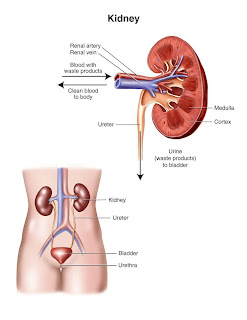
The functions of the kidney in the body are many. The kidneys
* retain glucose and arginine in the metabolism, are therefore involved in sugar metabolism and the formation of arginine
* make hormones like erythropoietin accelerated by the stimulation of bone marrow production of red blood cells,
* Renin, the importance for the regulation and aldosterone , and thus for the blood pressure and electrolyte balance plays a role
* Runs on vitamin D3 to the active, which regulates the thyroid and parathyroid glands, together with the kidney and the incorporation of calcium in the bones
* Separates from metabolic products mainly products from protein metabolism
* Separates contaminants for example, environmental toxins, food toxins, drugs

Thus, the kidney is responsible for the regulation of water balance, electrolyte balance, the acid- base balance, blood pressure, the formation of red blood cells and calcium metabolism. Restricts their function, are therefore depending on the severity of various body systems affected by the disorder

Cause:
The most common causes are hypertension, diabetes and taking painkillers. congenital However, an inflammation of the renal corpuscles, an inflammation of the kidneys (interstitial nephritis) , kidney cyst diseases polycystic nephropathy - usually leads to the age of 40 for kidney failure, systemic diseases such as vascular inflammation or Tissue diseases may lead to kidney failure.

Complaints:
Fatigue, loss of energy, anemia and its consequences, nausea , vomiting , cramps , numbness , reduction of brain power, water retention , cardiac arrhythmias , arteriosclerosis , hypertension, diabetes.

Prevention:
The most important prevention is to keep a healthy lifestyle with the normal weight , avoiding nicotine, note the rules for a healthy diet, plenty of fluid intake 2-3 liters per day, and set an optimal blood pressure, if possible 120/80. In addition, one should take medication as rare as possible; particularly painkillers should be avoided if possible.

Information on remedies for urinary tract infection and kidney stones problem. Also get more info and product for chronic kidney disease.